

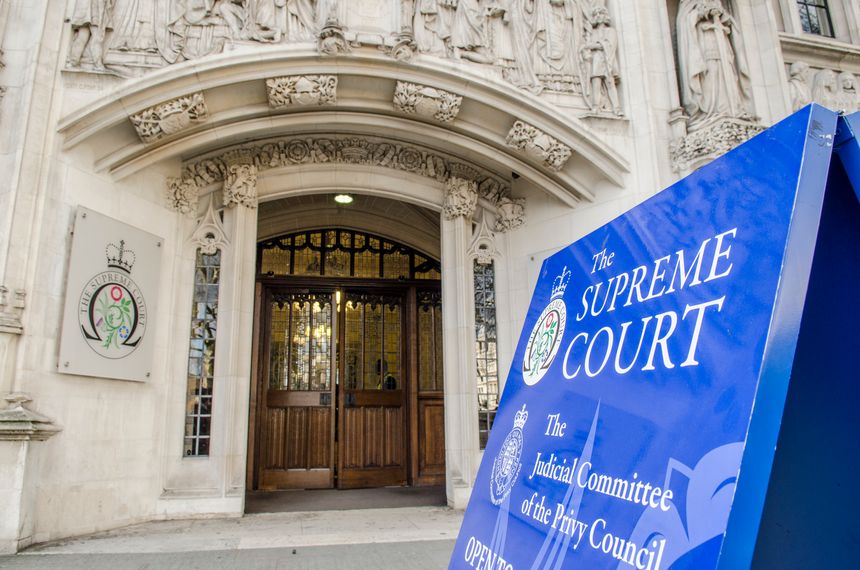
The Supreme Court handed down a much-anticipated judgment today in a long running construction case. The case concerned the correct interpretation of a contractual termination clause in the JCT 2016 form of construction contract, a form used throughout the UK and internationally. Accordingly, the case has been of significant interest to the construction industry.
Hexagon was the employer under the JCT contract and Providence Building Services Limited (“Providence”) was the contractor. Providence purported to terminate its employment in June 2023 because Hexagon had been late in paying Providence twice. Hexagon challenged the lawfulness of the termination on the grounds that Providence had incorrectly interpreted the termination clause.
In 2023 Hexagon’s interpretation won the day at adjudication and then before Adrian Williamson KC sitting as a Deputy High Court Judge in the TCC. Providence successfully appealed to the Court of Appeal in 2024, and Hexagon appealed to the Supreme Court – receiving permission to appeal in 2024 and with the matter being heard in 2025. Earlier today the Supreme Court unanimously found for Hexagon finding that the Court of Appeal had adopted the wrong approach when seeking to interpret the meaning of the relevant clause.
The case is important not just for its clarification of the meaning of the termination clause, but also because it summarises and confirms the approach courts should take when interpreting clauses in stand-form contracts.
Responding to the judgment from the Supreme Court, Hexagon’s chief executive, Sheron Carter, said:
“We are delighted to have been victorious in the Supreme Court which brings to an end the long legal battle with Providence. Our focus remains on completing the affected project to provide much needed affordable homes”.
Mark London, Senior Partner at Devonshires, who represented Hexagon, alongside Lena Barnes said:
“Having been somewhat surprised by the decision of the Court of Appeal I am now delighted that the Supreme Court have clarified the correct way to interpret the clause in question. In doing so it has brought certainty back to an industry where the use of JCT standard form is common.”.
Devonshires instructed Jonathan Lewis KC and Nicholas Kaplan of 4 Pump Court as counsel.
/Passle/6491ca5e863f054b458578e8/SearchServiceImages/2026-01-27-10-38-27-535-697895a3812a5c2d3450d260.jpg)
/Passle/6491ca5e863f054b458578e8/MediaLibrary/Images/2026-02-05-09-26-03-435-6984622bae0e4cf738f1e9cf.jpg)
/Passle/6491ca5e863f054b458578e8/SearchServiceImages/2026-02-04-14-23-41-412-6983566dd571d0784502ddba.jpg)
/Passle/6491ca5e863f054b458578e8/SearchServiceImages/2026-01-30-17-30-23-551-697ceaafcf6a75eb080faecb.jpg)