

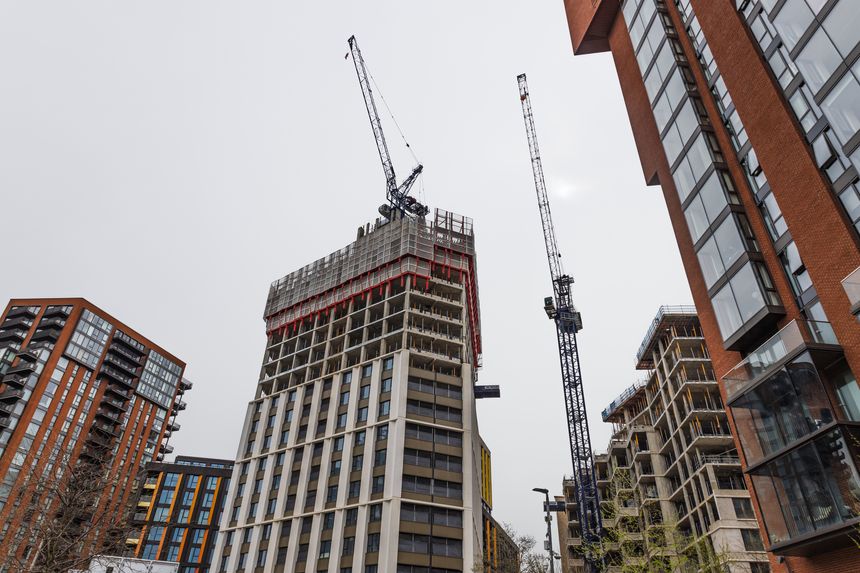
The Building (Higher-Risk Buildings Procedures) (Wales) Regulations 2025 ("the Regulations") was laid before the Senedd on 17 December 2025.
Much like the English equivalent, the Regulations introduce a new, more stringent building control system for higher-risk buildings, establishing stop/go “gateways" in the approval process and adding requirements for strict change control, golden thread facilities and mandatory occurrence reporting.
Key take aways from the Regulations
Broadly speaking, the English and Welsh regimes are very much alike. Those looking to construct HRBs or undertake any building work on existing HRBs will need to know the following:
- The Regulations will come into force on 1 July 2026, subject to transitional provisions. Any project where the initial notice was accepted, or where full plans are deposited, before 1 July 2026 will not be subject to the new regime.
- It applies to HRBs - defined in the Building Safety (Description of Higher-Risk Buildings) (Design and Construction Phase) (Wales) Regulations 2023 as at least 18 metres or having at least 7 storeys and containing at least one residential unit, one hospital bed for overnight stays, a care home or a children's home.
- The gateway process applies to both HRB work (the construction of or conversion to an HRB) and work to existing HRBs.
- Building control approval must be obtained before any HRB work or work to existing HRBs starts.
- Applications for new HRBs and Category A works to existing HRBs must contain prescribed information (competence declarations, construction control plan, change control plan, building regulations compliance statement etc.)
- There are limited exceptions for ‘scheme work’ (i.e., self-certification schemes), ‘exempt work’ (prescribed work set out in Schedule 2) and 'emergency repairs' (repairs that are necessary to be carried out as a result of an urgent risk to health, safety or welfare of persons in or around the building).
- Changes to plans for work, stages of work or strategies, policies or procedures must be recorded, notified to the building control authority where appropriate. Major changes will require further building control approval applications.
- An electronic golden thread facility will be required to record designs, application information and changes.
- A mandatory occurrence reporting system must be set up before construction begins to record and report design matters or incidents that present a risk of a significant number of deaths or injuries as a result of structural or fire safety issues.
- There is an enhanced handover procedure to ensure the responsible person has sufficient fire safety information and all relevant golden thread information.
Differences to the English process
While there English and Welsh processes are very similar (and exactly the same in many places), there are a few notable differences:
- The definition of ‘applicant’ specifically includes the Client under the Welsh regime, as well as the person making the application, highlighting the focus on accountability at all levels.
- Building control approval applications require more information regarding:
- the number of flats, residential rooms and commercial units there will be; and
- reports and calculations regarding structural loading calculations.
- More specificity in relation to the definition of Category A work to existing HRBs, including the meaning of active and passive fire safety measures.
- There is no requirement for a Welsh building control authority to provide reasons why an invalid application is rejected (although it still must give reasons where the application is rejected on any other grounds).
- Additional prescribed reasons why the building control authority might reject an application, including disagreement about point where oversight is required.
- There is no right to request paper copies of documents from the building control authority, the Welsh regime is strictly electronic.
- No requirement to provide handover information to the ‘accountable person’ as well as the ‘responsible person’.
- The scope of ‘scheme work’ is narrower and does not include matters within the table at 3A of the Building Regulations 2010.
- Completion certificate and partial completion certificate applications will require, as well as the mandatory occurrence reporting plan, a copy of all reports entered into the system.
- Additional compliance information in:
- the Building Regulations compliance statement setting out, if an approach in an applicable Approved Document is not followed, the reason for that departure and a signed statement from the Principal Designer confirming that the information is correct.
- The Fire and Emergency File to include a specific requirement for the proposed fire strategy demonstrating compliance with paragraphs A3 and B1-5 of the Building Regulations Schedule 1.
- An expanded ‘exempt work’ definition to include installation of thermal insulation in suspended timber floors.
- A simplified, pared down transitional arrangement to be applicable in circumstances where full plans are rejected or approval lapses – simply stating that the Regulations will apply.
As with the Building Safety (Wales) Bill, the Regulations present a (slightly) more stringent regime than it’s English counterpart. Therefore, those who are used to the English regime cannot assume like-for-like processes will apply in Wales; care must be taken to ensure full compliance with the Welsh rules.
If you have any queries about the upcoming change, contact our construction team for more information.
/Passle/6491ca5e863f054b458578e8/MediaLibrary/Images/2026-01-13-12-19-06-927-6966383a966611ff708def11.jpg)
/Passle/6491ca5e863f054b458578e8/SearchServiceImages/2026-01-15-12-45-35-027-6968e16fca11d5ca545a4b1a.jpg)
/Passle/6491ca5e863f054b458578e8/SearchServiceImages/2026-01-15-12-38-12-018-6968dfb4f76c97be8fb74ed6.jpg)
/Passle/6491ca5e863f054b458578e8/SearchServiceImages/2026-01-13-08-56-58-107-696608da7e4f0ca466e9ecee.jpg)